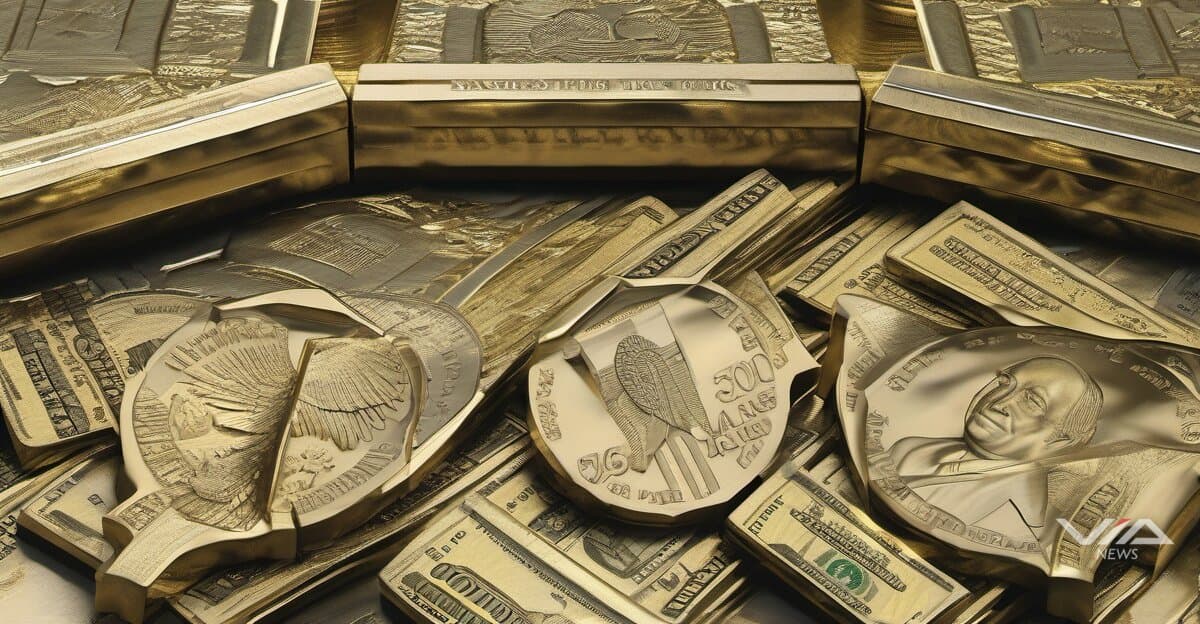
Central bank gold holdings reached approximately $4 trillion at the start of 2026, surpassing for the first time the roughly $3.9 trillion in US Treasuries held by the same institutions.1 The crossover is not symbolic. It reflects a structural reallocation of sovereign wealth away from dollar-denominated paper and toward physical assets held on home soil.
The catalyst was 2022. Washington's freeze of Russian foreign exchange reserves demonstrated that assets held in foreign custody carry political risk no rating agency had priced.2 Every central bank drew the same conclusion simultaneously. Physical gold stored in a domestic vault cannot be frozen by executive order in Washington.2 That single fact has since driven repatriation programs from Europe to Southeast Asia.
The shift landed against a charged backdrop. Alan Greenspan, the Fed chairman who anchored the era of dollar supremacy, died June 22 at age 100.3 His death marks a generational handoff at the Fed, coinciding almost precisely with the moment the institution he shaped lost its reserve-asset crown.
Commodity markets are pricing in the transition. Gold's appeal as a politically neutral, domestically custodied reserve has pushed prices higher, adding upward pressure on commodity indices and widening spreads in Treasury markets as foreign central bank demand for US debt softens.
Currency markets are adjusting in parallel. Japan's yen intervention and a recent Taiwan sovereign debt auction failure are signaling that the old dollar-centric order is under stress across Asia.4 Japan raised interest rates despite dissent from board member Toichiro Asada, who argued that Middle East conflict risks to growth outweighed inflation concerns.4 The split vote reflects how geopolitical risk is now embedded inside central bank rate decisions, not just reserve allocation.
Charles Goodhart's 1975 observation applies with precision: when a measure becomes a target, it ceases to be a good measure.5 The US Treasury, the world's risk-free benchmark for 80 years, became so central to the global system that sovereigns began managing around it rather than through it. The vault numbers now confirm the exit.
For commodity traders, the implication is a sustained bid under gold and increased forex volatility as reserve diversification continues. The dollar's role as the default settlement currency is not disappearing. But its monopoly on central bank balance sheets already has.