
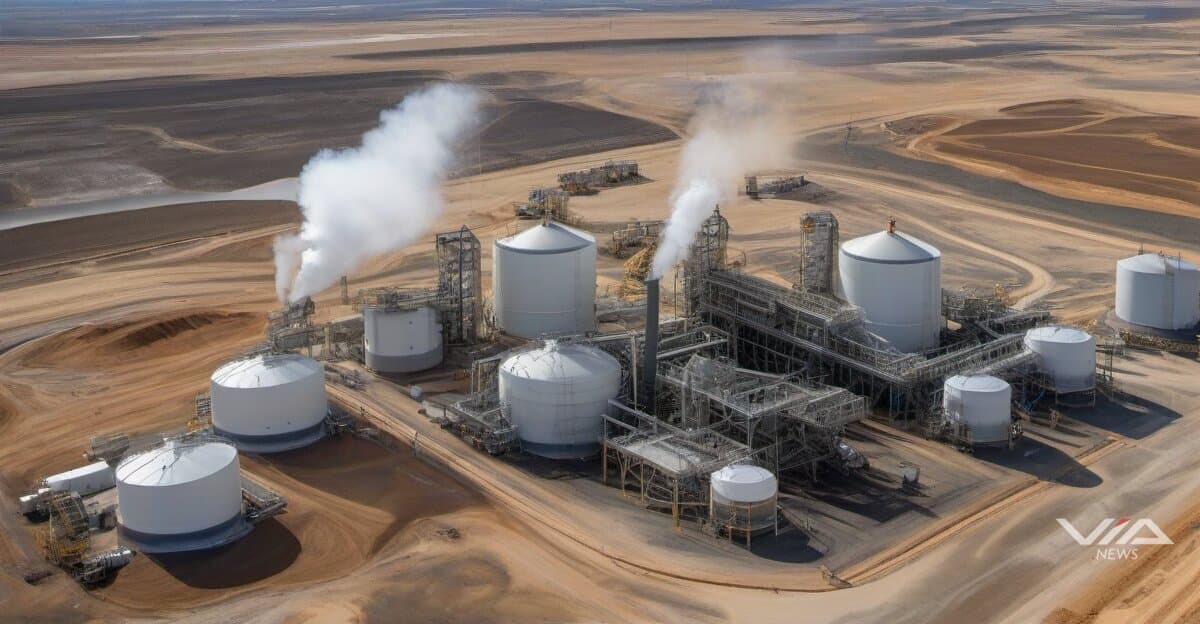
Canadian Natural Resources Limited (TSX: CNQ, NYSE: CNQ) is pressing ahead with a targeted expansion at its Horizon oil sands facility that will add 6,300 barrels per day of synthetic crude oil (SCO) to market by the third quarter of 2027 — a move that underscores the company's long-term confidence in Canadian bitumen upgrading even as global crude supply and demand balances remain contested.
The project, known internally as the Naphtha Recovery Unit Tailings Treatment (NRUTT), is designed to extract incremental SCO from material that would otherwise remain in tailings streams. By recovering naphtha from the tailings treatment process and reintroducing it into the upgrading circuit, Horizon can lift output without proportional increases in mining footprint or capital intensity — a key advantage in an era of tightening environmental scrutiny and rising abandonment costs.
Part of a Broader $6.4 Billion Capital Offensive
The NRUTT project sits within CNQ's 2026 operating and capital budget of $6.425 billion, announced in December 2025. Of that, $2.98 billion is earmarked for Thermal and Oil Sands Mining & Upgrading — nearly half the total program. The company is simultaneously drilling 252 net heavy crude oil wells in the Pelican Lake and Driftwood areas, advancing three CSS pads at Primrose with first production targeted in Q3 2026, and bringing a new SAGD pad at Kirby online in 2027.
Taken together, CNQ is guiding for total production of 1,590–1,650 MBOE/d in 2026, representing roughly 3% growth over 2025 at the midpoint. Liquids production is expected to grow faster, at approximately 5%, to between 1,177 and 1,220 Mbbl/d. The NRUTT increment in 2027 would layer additional SCO barrels on top of that trajectory.
Supply Dynamics: What 6,300 bbl/d Means for Markets
On an absolute basis, 6,300 bbl/d is modest relative to global crude benchmarks. But in the context of Canadian SCO — a premium-quality, low-sulphur stream that competes directly with light sweet grades on US Gulf Coast and Midwest refineries — incremental volumes matter. SCO commands pricing closer to WTI than to Western Canadian Select, meaning each additional barrel carries stronger netback implications for CNQ and adds to the pool of upgrader-derived supply available to North American refiners.
For commodity traders, the timing is relevant. The NRUTT start in Q3 2027 will coincide with a period when Trans Mountain Expansion pipeline capacity — now fully operational — is reshaping the egress picture for Alberta barrels. More pipeline optionality means Canadian producers are less price-tethered to US Midwest buyers, potentially compressing the historical WCS-WTI differential and improving realized prices across the board.
Risks: Tariffs, OPEC+, and Emissions Caps
CNQ's budget documentation is candid about the macro headwinds. US-imposed tariffs and potential Canadian countermeasures represent an evolving trade risk that could affect cross-border energy flows and input costs. OPEC+ production decisions remain a key swing factor for global crude benchmarks, and any sustained price weakness would pressure free cash flow — CNQ reported just $379 million in free cash flow in Q3 2025 against adjusted funds flow of $3.92 billion, reflecting the capital intensity of its current investment cycle.
Regulatory risk is also non-trivial. Potential federal emissions or production caps in Canada could constrain the operating envelope for oil sands expansion projects, including NRUTT, if policy tightens before the 2027 production start.
Bottom Line for Investors
CNQ's NRUTT project is emblematic of the company's philosophy: extract more value from existing infrastructure rather than greenfielding new capacity. President Scott Stauth described the 2026 program as "anchored around unparalleled assets, execution, and resilience." For market participants tracking Canadian crude supply growth, the Q3 2027 NRUTT ramp is a data point worth holding — incremental, technically defined, and backed by a balance sheet carrying $17.1 billion in net debt that management is actively working to reduce through its tiered free cash flow allocation framework.