
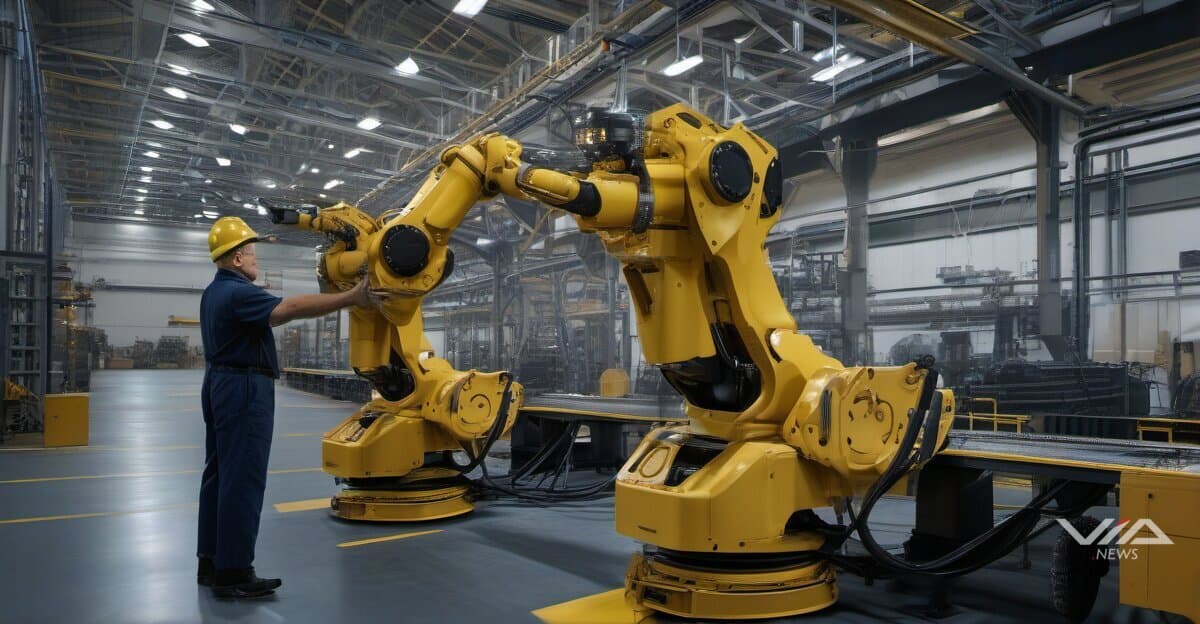
Defense Spending at Historic Highs Fuels Automation Investment Cycle
The U.S. defense industrial base is entering a new capital deployment phase. With Congress passing an $839 billion defense authorization bill, the sector is flush with funding directed not only at weapons systems but increasingly at the manufacturing infrastructure required to build them at scale. The beneficiaries extend well beyond prime contractors—they reach deep into the supply chain, into robotics integrators, AI software firms, and advanced materials producers.
For equity investors, the signal is clear: this isn't a one-quarter procurement spike. It's a structural realignment of how America builds its defense capacity, and the companies enabling that shift are positioned for multi-year revenue tailwinds.
Howmet Aerospace: The Benchmark for Sector Momentum
Few companies illustrate the current aerospace manufacturing boom better than Howmet Aerospace (HWM). The Pittsburgh-based manufacturer of engineered components—turbine blades, fasteners, structural castings—posted record performance metrics in recent quarters, driven by sustained demand from both commercial aviation recovery and defense procurement cycles. Howmet's results underscore that the aerospace supply chain is operating at capacity, with premium pricing power for precision-manufactured components.
Howmet's trajectory matters to defense equity watchers because it reflects a broader dynamic: the defense and aerospace sectors are not just spending more, they are spending on increasingly sophisticated hardware that requires automated, high-precision fabrication. That creates durable demand for the automation ecosystem surrounding these manufacturers.
Physical AI Moves from Pilot to Infrastructure: The HII-Path Robotics Model
Perhaps the most consequential emerging development in defense manufacturing is the deployment of physical AI—autonomous robotic systems capable of performing skilled industrial tasks without human intervention. Huntington Ingalls Industries (HII), the nation's largest military shipbuilder, has partnered with Path Robotics to integrate AI-driven welding systems into naval vessel construction.
Welding is one of the most labor-intensive and skill-dependent processes in shipbuilding. Automating it with AI systems that can adapt in real time to material variances and complex geometries represents a step-change in throughput and consistency. For HII, the operational case is compelling: the U.S. Navy's shipbuilding backlog is substantial, and labor constraints have historically been a bottleneck. Autonomous welding directly addresses that constraint.
This isn't an isolated case. Across defense-adjacent manufacturing—aircraft assembly, ground vehicle production, munitions fabrication—driverless ground support vehicles and AI-assisted quality control systems are migrating from experimental programs to standard operating procedure.
Investment Implications: Where Capital Is Flowing
For portfolio managers and active traders, three equity themes emerge from this convergence:
- Defense prime contractors with automation integration programs (HII, General Dynamics, L3Harris) stand to improve margins as physical AI reduces per-unit labor costs.
- Precision components manufacturers like Howmet operate in a supply-constrained environment where pricing power and volume growth are simultaneously favorable.
- Industrial robotics and AI integrators—both public and pre-IPO—are capturing long-duration contracts as defense primes embed automation into multi-decade platform programs.
The $839 billion authorization provides the fiscal foundation. Howmet's results confirm the demand environment. And HII's robotics deployment confirms the technology is production-ready. Together, they form a coherent bull case for defense manufacturing automation equities that extends well into the decade.