
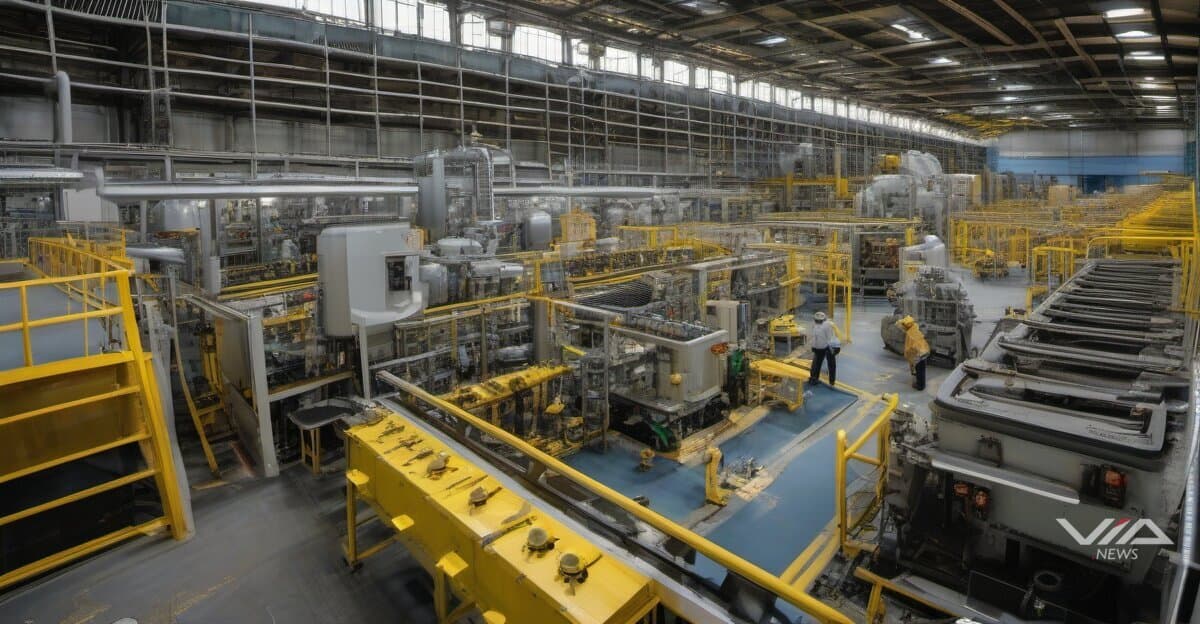
ProLogium Technology has achieved a genuine industrial milestone: the Taoyuan giga-factory is the world's first facility capable of producing solid-state batteries at gigafactory scale. That distinction is significant for the EV supply chain globally. But milestone status does not insulate the asset from geography — and in this case, geography is the single most material risk variable for any investor underwriting exposure to this company or the broader solid-state battery sector.
Taiwan-based manufacturing concentration has been a recurring theme in semiconductor equity risk analysis for years. The same logic now applies with compounding urgency to the battery sector. ProLogium's Taoyuan facility represents a substantial concentration of both capital investment and proprietary production capacity in a jurisdiction that sits at the fault line of U.S.-China strategic competition. Cross-strait tensions have not diminished; if anything, the deterioration in bilateral relations since 2022 has elevated the probability weighting attached to disruption scenarios.
Risk assessors currently assign a medium likelihood to a disruption event affecting Taiwan-based manufacturing assets, while classifying the potential impact as catastrophic in severity — a combination that produces an elevated expected-loss figure that warrants explicit disclosure in any equity or credit analysis. The confidence interval on that assessment sits at 0.70, meaning analysts have a relatively high degree of conviction in the scenario construction, even if the precise timing remains unknowable.
For EV OEMs that have signed offtake agreements or entered partnership arrangements with ProLogium — including European automakers that have publicly committed to solid-state battery roadmaps — the implications extend beyond one supplier's valuation. A disruption to Taoyuan production capacity would cascade into vehicle program delays, forcing manufacturers to either revert to conventional lithium-ion chemistries or absorb significant schedule slippage on next-generation platforms. Either outcome is margin-dilutive.
The export control dimension adds a second vector. U.S. and allied governments have demonstrated increasing willingness to impose restrictions on advanced manufacturing technologies with dual-use potential. Solid-state battery technology, given its applications in defense platforms and grid storage alongside passenger EVs, is not immune to this regulatory trajectory. A tightening export control regime could constrain ProLogium's ability to ship product, license technology, or attract foreign capital — independent of any kinetic scenario.
Investors assessing the solid-state battery space should apply a Taiwan concentration discount to valuations that assume uninterrupted production ramp. The standard discounted cash flow models used to justify high multiples on pre-revenue or early-revenue battery technology companies typically assign negligible probability to facility-level disruption. That assumption requires revision. Scenario analysis should incorporate at minimum a 12-to-36 month production outage case, with associated revenue haircut and capital replacement cost estimates.
Geographic diversification of manufacturing capacity — either through announced expansion into Europe or North America — would be the most direct mitigant. Until such capacity is operational and validated, the Taoyuan concentration remains an unhedged single-point-of-failure in the solid-state battery supply chain. For a sector already demanding patient capital and tolerance for commercialization risk, adding uncompensated geopolitical tail risk is a material consideration that equity valuations have not yet fully reflected.