
Wednesday, August 26, 2026

Industrial Robot Sales Surge as AI Processors Target Factory Automation

Industrial automation robot sales hit multi-year highs as labor constraints force manufacturers toward AI-enhanced robotics, according to International Federation of Robotics data. CoreWeave's capital expenditure will double to $30 billion in 2026 from $15.4 billion in 2025, signaling infrastructure demand for AI workloads. AMD and Marvell Technology are positioning edge AI processors and data infrastructure for the automation wave.

Industrial Robot Sales Surge as AI Processors Target Factory Automation
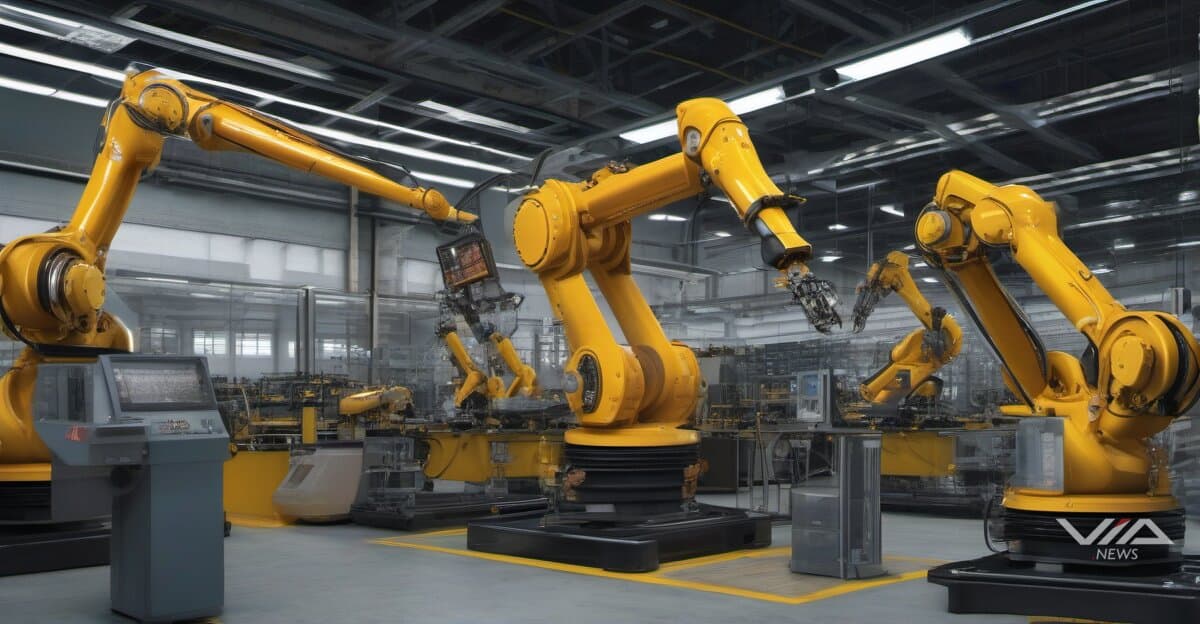
Image generated by AI for illustrative purposes. Not actual footage or photography from the reported events.
Loading stream...

Industrial robot sales reached significant growth levels in recent quarters, driven by labor shortages and expanded AI capabilities, per International Federation of Robotics reporting. The trend is pulling chip designers into factory automation markets previously dominated by traditional programmable logic controllers.

CoreWeave projects capital expenditures will reach at least $30 billion in 2026, up from $15.4 billion in 2025. The doubling reflects demand for AI infrastructure that supports robotics training and edge deployment. Marvell Technology posted Q3 net revenue of $2.08 billion, indicating strength in data infrastructure components feeding automation systems.

AMD launched Ryzen AI 400 Series processors designed for Copilot+ experiences, marking chip makers' push into intelligent edge devices. Jack Huynh stated the desktop PC is shifting from tool to intelligent assistant. The same processor architecture applies to industrial controllers managing robotic systems with vision processing and predictive maintenance algorithms.

The automation buildout differs from prior cycles. Earlier industrial robots required extensive programming for fixed tasks. Current systems use AI models trained on cloud infrastructure, then deployed to edge processors in factories. This creates dual revenue streams: cloud training infrastructure and edge inference chips.

Labor constraints are structural. Manufacturing facilities in developed markets face sustained worker shortages, making automation economics favorable even at higher initial costs. AI capabilities expand robot applications beyond repetitive tasks to quality inspection, adaptive assembly, and collaborative work alongside human operators.

Investors should monitor industrial robot shipment volumes against edge AI processor sales. The correlation will test whether chip demand scales with automation adoption. Capital expenditure trends at AI infrastructure providers like CoreWeave signal confidence in sustained robotics workload growth.

Key validation points include tracking adoption rates of AI-enabled versus traditional automation systems, and measuring whether specialized compute hardware sales match robotics deployment rates across manufacturing sectors.

In this story · Knowledge Files

What we know · the intelligence behind this page
Live from the substrate
What we're seeing
AI Leadership Exodus Rattles Investor Confidence Amid Capex Boom
High-profile departures at top AI labs — Brad Lightcap's exit from OpenAI and an unnamed researcher's departure from Alphabet/Google that triggered a share-price drop — are surfacing talent retention as a market risk factor even as hyperscalers pour record capital into AI infrastructure. The reaction shows investors treating key-person risk at frontier AI labs as material to valuation, a new fragility layered onto an otherwise bullish AI-driven capex cycle.
Our read on the data ›
Signals we're tracking
EPKINLY Regulatory-Clinical Success Cascade
High probability of expanded label indications, additional combination approvals, and competitive positioning strength in follicular lymphoma market. Predicts positive commercial uptake and potential accelerated review for related indications.
Patterns we're watching ›
Where sources disagree
Broadcom Inc.
Both facts report EPS for Broadcom Inc. for the same fiscal period (Q1 2026) observed on the same date (2026-02-01). However, they report conflicting values: 1.5 USD per share vs 2.05 USD per share. This is a 37% difference for the identical metric and time period, not a value change over time.
We flag conflicts openly ›
Recently verified
Checked against the original source
4,978
facts traced to their source — and we flag the ones that don't hold up.
101 entities tracked4,978 facts checked against source5,251 source documents archived
Query this data → isubstrate.com