
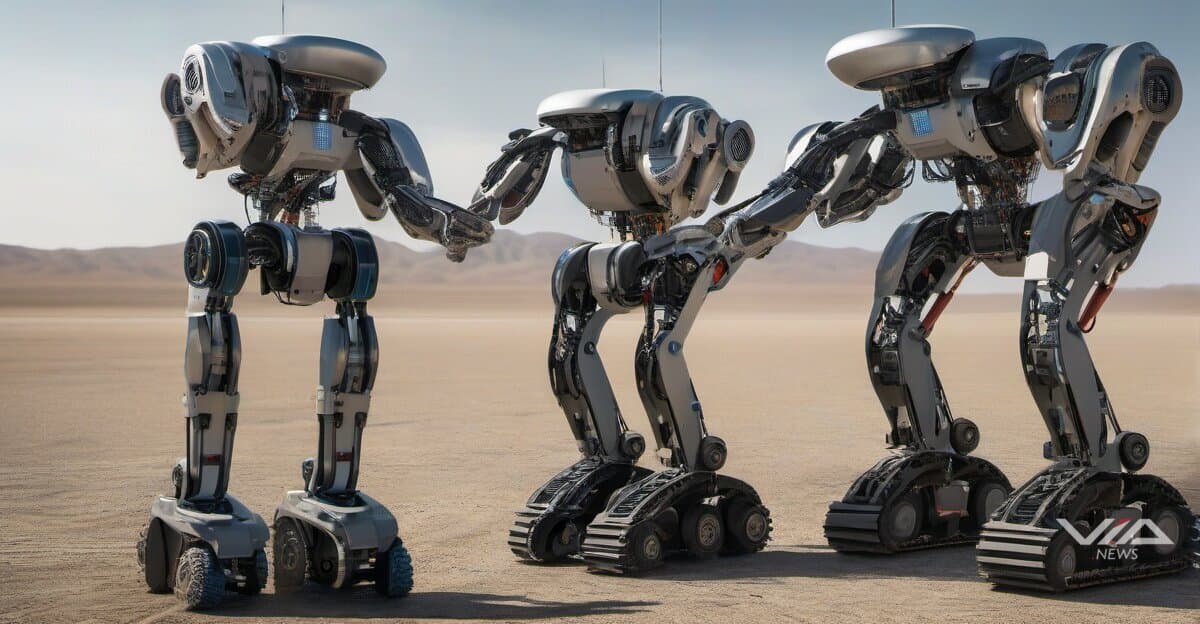
The robotics industry is crossing a threshold that equity markets have been anticipating for years: the shift from expensive, small-scale pilots to genuine mass deployment. For investors, the question is no longer whether autonomous systems will scale — it is which companies will capture the margin as they do.
The Macro Setup
Hardware economics are finally cooperating. Hesai Technology, one of the dominant LiDAR suppliers feeding autonomous vehicle and robotics platforms, is targeting sub-$200 price points for its next-generation ATX LiDAR. That figure matters enormously for unit economics across the value chain: cheaper sensing makes humanoid robots and autonomous vehicles closer to cost-competitive with human labor in high-turnover environments like warehouses and last-mile logistics. Analysts tracking the automotive LiDAR market project it reaching $25.75 billion by 2035, but the near-term story is about cost deflation unlocking deployments that were previously uneconomical.
WeRide: The Pure-Play Signal
WeRide Inc. (NASDAQ: WRD) offers perhaps the clearest financial signal that commercialization is accelerating. The company's Q3 2025 earnings revealed total revenue of $24.0 million — up 144.3% year-over-year — with robotaxi revenue specifically surging 761% YoY to $5.0 million, now representing 20.7% of the total revenue mix versus just 5.8% a year prior. Gross margin expanded dramatically, from 6.5% to 32.9%, suggesting the unit economics of scaled operations are beginning to assert themselves.
WeRide operates across 30+ cities in 11 countries, holds autonomous vehicle licenses in eight jurisdictions, and is targeting a public passenger service launch in Singapore in early 2026. With $764 million in liquid assets on its balance sheet against $34.4 million in short-term borrowings, the company has the runway to absorb continued R&D spending — which rose 39.4% excluding stock-based compensation — while pursuing those milestones. For investors, WRD represents a high-conviction bet on autonomous mobility with improving fundamentals.
Mobileye Moves into Humanoids
Mobileye's acquisition of Mentee Robotics signals a strategic pivot worth noting. Prof. Lior Wolf, representing Mentee, framed the deal as gaining access to "unparalleled AI infrastructure and commercialization expertise" to bring "scalable, safe, and cost-effective humanoid solutions to market." For Mobileye shareholders, it repositions the company beyond automotive ADAS into the broader physical AI stack — a higher-multiple business if humanoid deployment timelines prove accurate. The 2026–2028 window for mass humanoid launches is now backed by a credible commercialization partner.
Tesla and Amazon: The Institutional Anchors
Tesla's Optimus program and Amazon Robotics remain the large-cap entry points for investors seeking robotics exposure with lower single-stock risk. Tesla's vertical integration — motors, batteries, AI training infrastructure, and manufacturing scale — gives it a structural cost advantage in humanoid production that pure-play startups will struggle to match at volume. Amazon Robotics, meanwhile, represents a captive deployment environment: the company can absorb automation at scale across its fulfillment network before any external commercialization, de-risking the technology curve in ways no standalone robotics firm can replicate.
Market Implication
The convergence of falling hardware costs, expanding regulatory approvals, and improving unit economics across autonomous vehicles and humanoid robots points to a structural re-rating opportunity in the sector. Near-term catalysts include WeRide's Singapore launch, Mobileye's integration of Mentee's humanoid IP, and Tesla's Optimus production ramp guidance. Investors should monitor gross margin trajectories at pure-play names as the clearest leading indicator that commercialization is delivering on its promise — not just its narrative.