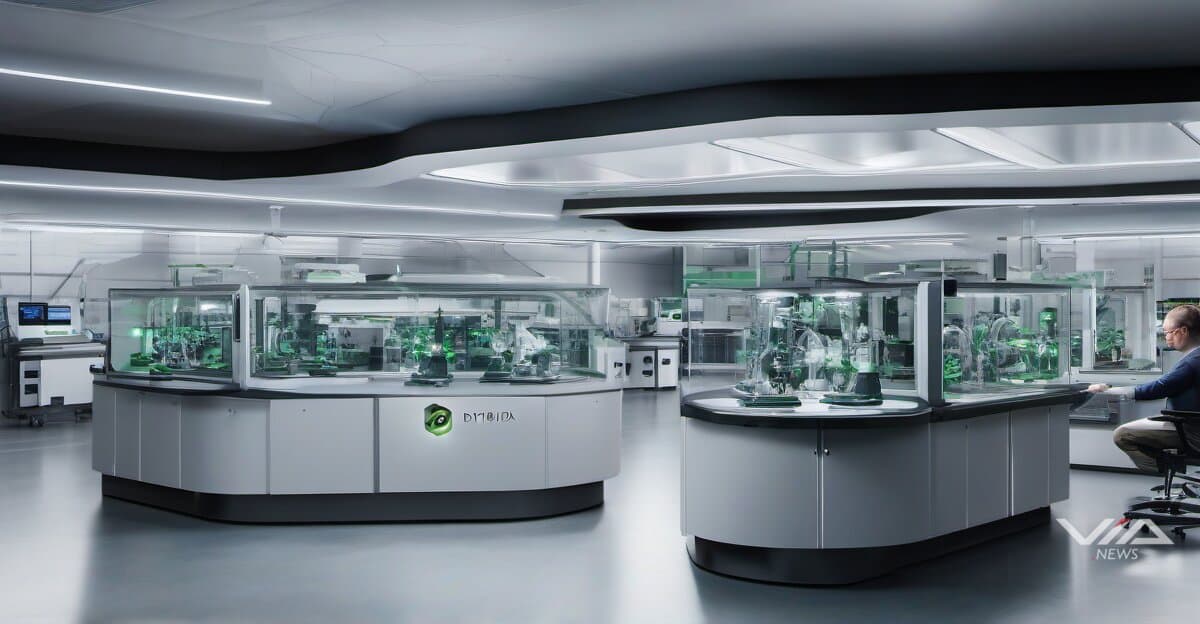
NVIDIA secured partnerships with Eli Lilly and Thermo Fisher to deploy its BioNeMo platform for AI-driven drug discovery, establishing the chipmaker as foundational infrastructure for pharmaceutical research.1 The platform targets computational biology workflows that require massive GPU clusters for protein folding, molecular simulation, and genomic analysis.
Five biotech AI companies—Natera, Basecamp Research, Owkin, Edison Scientific, and Boltz Lab—launched foundation model platforms in coordinated timing, signaling industry-wide adoption of AI-native drug discovery.1 This concentration of launches indicates biotech firms are racing to build proprietary models before competitors establish market dominance.
The shift creates sustained semiconductor demand beyond NVIDIA's traditional gaming and data center markets. Drug discovery models require continuous GPU access for training on molecular databases, unlike inference-focused applications that need less compute power. Pharmaceutical companies historically spent on wet lab equipment; AI infrastructure budgets now compete for the same capital allocation.
Biotech AI valuations face pressure as competitive moats narrow. Companies building foundation models need differentiated datasets or novel architectures to justify premium pricing when NVIDIA's platform commoditizes base capabilities. Natera's advantage lies in proprietary genetic testing data; pure-play AI firms without unique data assets risk margin compression.
NVIDIA's biotech expansion diversifies revenue streams as gaming GPU sales plateau and hyperscaler capex growth decelerates. Pharmaceutical partnerships offer longer sales cycles but higher switching costs once workflows integrate with BioNeMo infrastructure. Eli Lilly's participation validates enterprise demand beyond pilot programs.
The transformation pressures traditional pharma IT vendors. Life sciences software providers must integrate AI capabilities or lose ground to NVIDIA's ecosystem. Thermo Fisher's partnership suggests established players are partnering rather than building competing platforms, cementing NVIDIA's position.
Investors should monitor GPU allocation metrics in pharma earnings calls and biotech AI startup funding rounds. Rising infrastructure spend signals genuine workflow adoption versus speculative AI experimentation.