
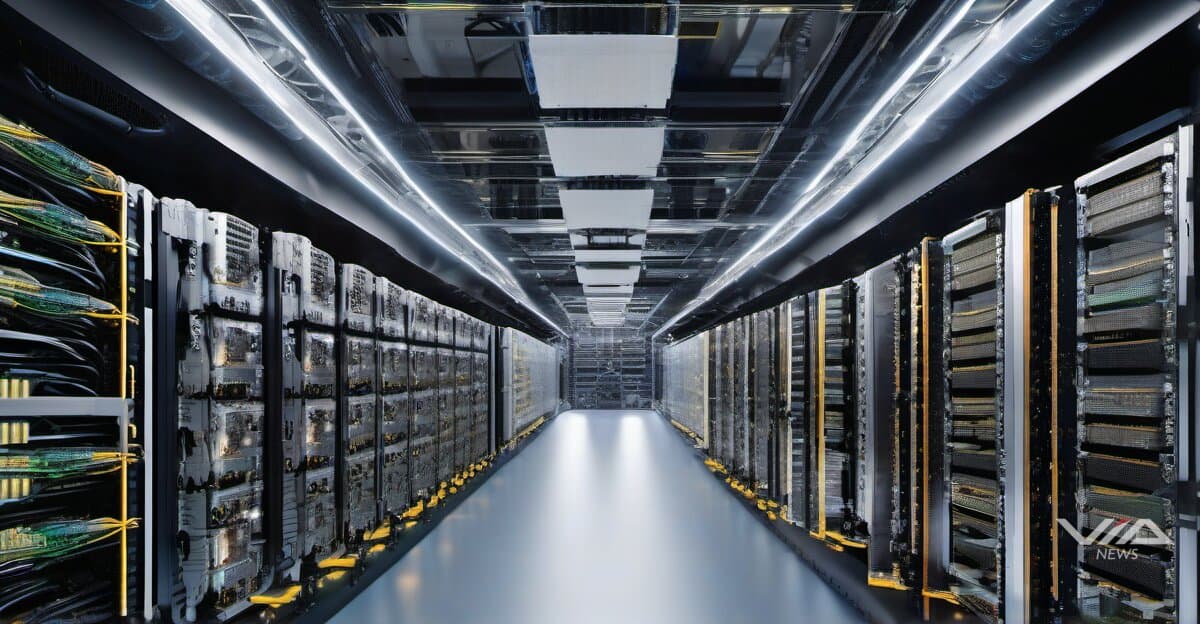
The AI hardware infrastructure race is accelerating across multiple semiconductor layers, with specialty players posting aggressive capacity expansion plans and forward guidance that signals sustained investment cycles through 2027.
Credo Technology, a key player in data center connectivity, is guiding GAAP gross margins between 63.8% and 65.8% for Q3 FY2026—a notably healthy range that reflects strong demand for high-bandwidth interconnect solutions critical to AI cluster buildouts. As hyperscalers deploy increasingly dense GPU configurations, connectivity bottlenecks have emerged as a primary constraint, positioning Credo's solutions at a strategic chokepoint in the infrastructure stack.
Aehr Test Systems reported more challenging near-term financials but delivered bullish long-term signals. Q2 FY2026 revenue fell 27% year-over-year to $9.9M, with non-GAAP gross margin compressing to 29.8% from 45.3% due to lower WaferPak volumes and unfavorable product mix. However, the company raised $10M through an ATM offering and guided second-half FY2026 bookings to $60M-$80M, driven primarily by AI wafer-level and packaged-part burn-in demand.
The critical development: Aehr's lead Sonoma production customer provided a "very large forecast" for AI ASIC testing, with shipments expected to commence in Q1 FY2027. Post-quarter bookings reached $6.5M in just six weeks, pushing effective backlog to $18.3M. CEO Gayn Erickson emphasized production capacity exceeding 20 systems per month for both wafer and package-level testing—infrastructure designed to support the industry's shift toward high-power AI chips requiring up to 2,000 watts per device.
The company's partnership expansion with ISE Labs and ASE for wafer-level and packaged-part testing services targeting "top-tier semiconductor customers" in HPC and AI applications underscores the ecosystem's maturation. As AI chip complexity escalates, testing and burn-in capacity represents an often-overlooked bottleneck that could constrain production ramps.
Ensurge Micropower rounds out the infrastructure buildout narrative on the power management front, addressing edge compute and IoT requirements that complement centralized AI data center investments. While less prominently featured in earnings releases, the company's inclusion in the AI hardware ecosystem signals growing recognition that power efficiency innovations will prove critical as AI workloads proliferate beyond hyperscale facilities.
Market Context and Competitive Dynamics
The infrastructure push occurs against a backdrop of explosive projected growth: the AI processor market is forecast to expand from $43.7B to over $323B, a trajectory that demands parallel investment across the entire supply chain. Google's custom silicon strategy and emerging alternatives signal that Nvidia's dominance faces increasingly targeted challenges, particularly in specialized workload optimization and total-cost-of-ownership considerations.
Critical bottlenecks around the "memory wall"—the gap between processor speed and memory bandwidth—and advanced packaging technologies are defining the next competitive frontier. Companies solving these constraints, whether through high-bandwidth memory integration, advanced interconnects, or thermal management innovations, stand to capture disproportionate value.
For investors, the near-term margin compression at companies like Aehr reflects typical capacity expansion dynamics: short-term profitability sacrifice in exchange for positioning in a rapidly scaling market. The $60M-$80M bookings guidance against $9.9M quarterly revenue illustrates the dramatic demand inflection these companies anticipate.
The infrastructure layer—often overshadowed by headline GPU announcements—may prove the more durable investment theme as AI deployment matures from proof-of-concept to production scale.