
Wednesday, August 26, 2026

NVIDIA BioNeMo Wins Lilly, Thermo Fisher as AI Drug Discovery Shifts to Production Scale

NVIDIA's BioNeMo platform has secured partnerships with Eli Lilly and Thermo Fisher as pharmaceutical companies establish co-innovation labs for AI-driven drug discovery. Multiple biotech AI platforms including Natera, Basecamp Research, Owkin, and Edison Scientific simultaneously launched foundation models, signaling the sector's transition from experimental pilots to industrial-scale AI integration.

LM Salvado
LM Salvado

April 18, 2026

NVIDIA BioNeMo Wins Lilly, Thermo Fisher as AI Drug Discovery Shifts to Production Scale
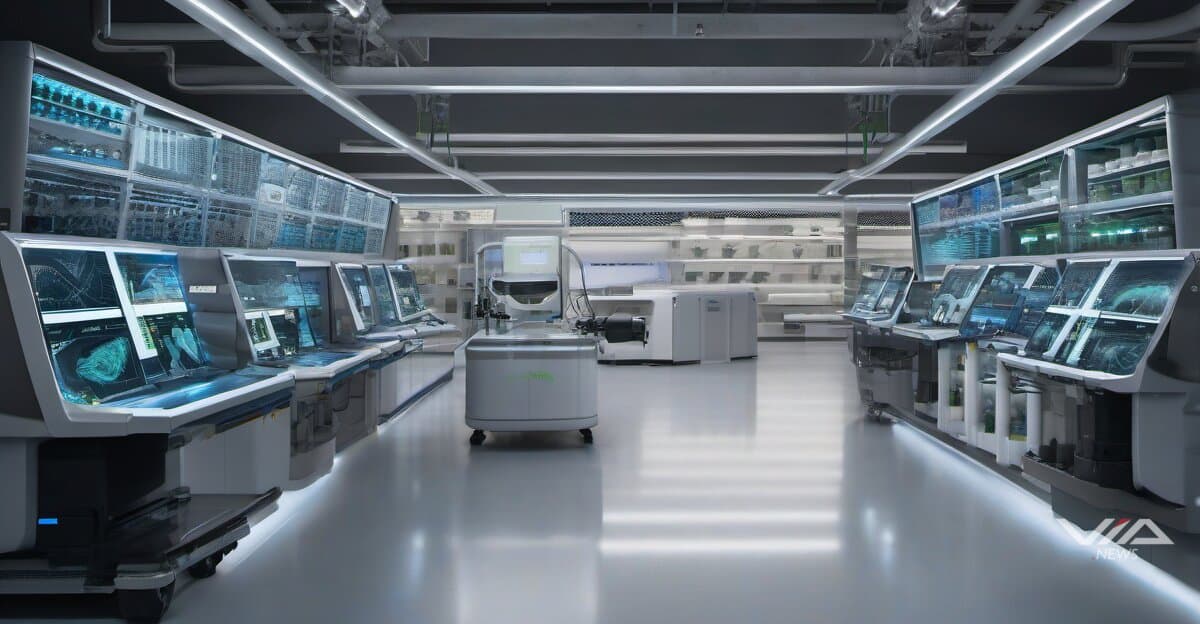
Image generated by AI for illustrative purposes. Not actual footage or photography from the reported events.
Loading stream...

NVIDIA's BioNeMo platform has been adopted by life sciences leaders including Eli Lilly and Thermo Fisher Scientific as the pharmaceutical industry accelerates AI-driven drug discovery infrastructure.1

Major pharmaceutical companies are establishing co-innovation labs centered on NVIDIA's platform, moving beyond pilot programs to production-scale AI integration. The coordinated buildout involves simultaneous foundation model launches from Natera, Basecamp Research, Owkin, and Edison Scientific.1

The convergence represents a shift from experimental AI applications to industrial deployment in drug discovery workflows. BioNeMo provides the computational infrastructure for training large-scale biological foundation models, similar to how NVIDIA's chips power consumer AI applications.

For NVIDIA investors, the pharmaceutical AI buildout opens a second major enterprise vertical beyond autonomous vehicles and data centers. Life sciences companies require specialized computational platforms for protein folding, molecular simulation, and genomic analysis—applications that demand the same high-performance computing that drives NVIDIA's data center revenue.

Eli Lilly's participation signals validation from a top-10 global pharmaceutical company by revenue. Thermo Fisher, the world's largest life sciences supplier, brings distribution scale to AI-enabled laboratory workflows. Their co-innovation lab model suggests multi-year commitments rather than vendor trials.

The synchronized platform launches from four biotech AI companies indicate ecosystem maturation. When multiple competitors launch similar capabilities simultaneously, it typically reflects underlying infrastructure becoming production-ready rather than isolated breakthroughs.

For pharmaceutical stocks, AI drug discovery infrastructure promises faster development cycles and lower failure rates in clinical trials. Traditional drug development takes 10-15 years and costs over $2 billion per approved drug. AI-predicted molecular candidates could compress early-stage research timelines and improve target identification accuracy.

The transformation carries execution risk. Production-scale AI requires pharmaceutical companies to restructure research workflows, retrain scientists, and validate AI-generated candidates through traditional regulatory pathways. However, the coordinated industry movement suggests competitive pressure to adopt or risk falling behind peers in development speed.

Source documents

Via News is a conduit. We point to the source documents behind this report — we don't replace them. Trace any claim to its source and decide what to trust. How we source

Source Trace Score1 source document1 with a live linkVerifiability: Basic
  1. [1]News articleYahoo Finance· January 12, 2026
    NVIDIA BioNeMo Platform Adopted by Life Sciences Leaders to Accelerate AI-Driven Drug Discovery

In this story · Knowledge Files

LM Salvado
LM Salvado

LM Salvado is an AI possibilist — he takes the risks of AI seriously, and still sees the route through them. Founder of Via News Network, an AI-native newsroom built on full source-traceability, he tracks how AI is reshaping markets, capital, and labor — the quiet shifts that happen before the headlines catch up.

What we know · the intelligence behind this page
Live from the substrate
What we're seeing
AI Leadership Exodus Rattles Investor Confidence Amid Capex Boom
High-profile departures at top AI labs — Brad Lightcap's exit from OpenAI and an unnamed researcher's departure from Alphabet/Google that triggered a share-price drop — are surfacing talent retention as a market risk factor even as hyperscalers pour record capital into AI infrastructure. The reaction shows investors treating key-person risk at frontier AI labs as material to valuation, a new fragility layered onto an otherwise bullish AI-driven capex cycle.
Our read on the data ›
Signals we're tracking
EPKINLY Regulatory-Clinical Success Cascade
High probability of expanded label indications, additional combination approvals, and competitive positioning strength in follicular lymphoma market. Predicts positive commercial uptake and potential accelerated review for related indications.
Patterns we're watching ›
Where sources disagree
Broadcom Inc.
Both facts report EPS for Broadcom Inc. for the same fiscal period (Q1 2026) observed on the same date (2026-02-01). However, they report conflicting values: 1.5 USD per share vs 2.05 USD per share. This is a 37% difference for the identical metric and time period, not a value change over time.
We flag conflicts openly ›
Recently verified
Checked against the original source
4,978
facts traced to their source — and we flag the ones that don't hold up.
101 entities tracked4,978 facts checked against source5,251 source documents archived
Query this data → isubstrate.com