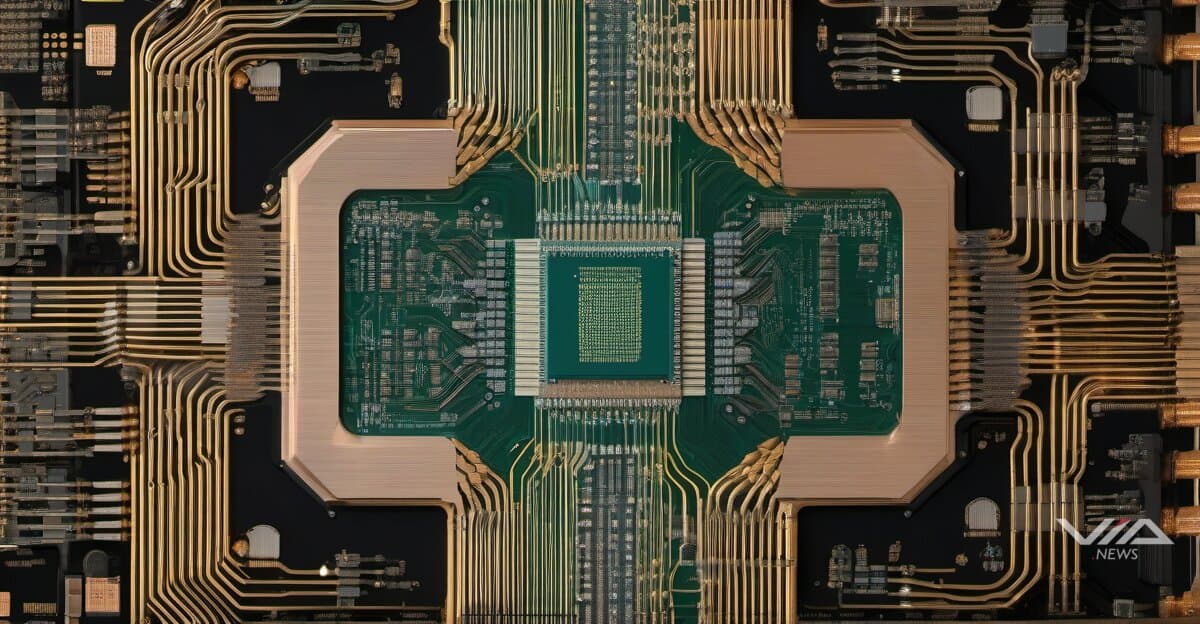
Olix has set a 2027 target for its first photonic chip product, positioning itself in an AI semiconductor market attracting record capital flows.
The startup's timeline coincides with major AI infrastructure investments. OpenAI secured $110B in funding while Anthropic raised $30B, both rounds signaling institutional backing for next-generation AI hardware ecosystems. MatX added $500M to develop AI-optimized chip architectures.
Photonic chips use light instead of electricity for data transmission, potentially offering speed and power efficiency advantages for AI workloads. The technology represents an alternative to conventional GPU and TPU designs that currently dominate AI training and inference.
Nio's subsidiary GeniTech is pursuing specialized chips for autonomous driving applications. The emergence of domain-specific players challenges the one-size-fits-all approach of general-purpose AI accelerators.
Tooling providers are adapting to diversified chip architectures. Synopsys released OptoCompiler for photonic circuit design, while its VC Functional Safety Manager targets automotive-grade silicon verification. These tools reduce barriers for companies developing specialized AI chips.
Canada's CFI committed $552M to research infrastructure supporting semiconductor development, reflecting government recognition of strategic importance. Public funding complements private capital in building capabilities beyond established players.
The capital concentration in AI has created urgency around chip performance bottlenecks. Training frontier models requires massive compute capacity, driving demand for architectures optimized for transformer networks and other AI-specific workloads.
Traditional semiconductor firms face competition from vertical integration. Major AI companies are designing custom chips to control their technology stacks and reduce dependence on third-party suppliers.
Olix's 2027 product launch will enter a market testing whether photonic technology can deliver commercial advantages at scale. The company faces execution risks typical of hardware startups: manufacturing partnerships, yield optimization, and customer validation.
Investment in specialized AI chips reflects a bet that workload diversity will reward purpose-built architectures over general-purpose solutions. The next two years will determine which approaches gain market traction as products ship and performance claims meet real-world testing.