
Wednesday, August 26, 2026

NVIDIA and Hyperscalers Hit All-Time Highs as Markets Price AI Compute Scarcity

NVIDIA and major hyperscaler stocks have reached all-time highs, with markets assigning a structural premium to AI compute infrastructure. US electricity grid constraints are driving the thesis: physical bottlenecks make existing AI infrastructure more valuable. Adjacent sectors — power generation, grid operators, cooling, and data center REITs — are being repriced as downstream beneficiaries.

LM Salvado
LM Salvado

June 23, 2026

NVIDIA and Hyperscalers Hit All-Time Highs as Markets Price AI Compute Scarcity
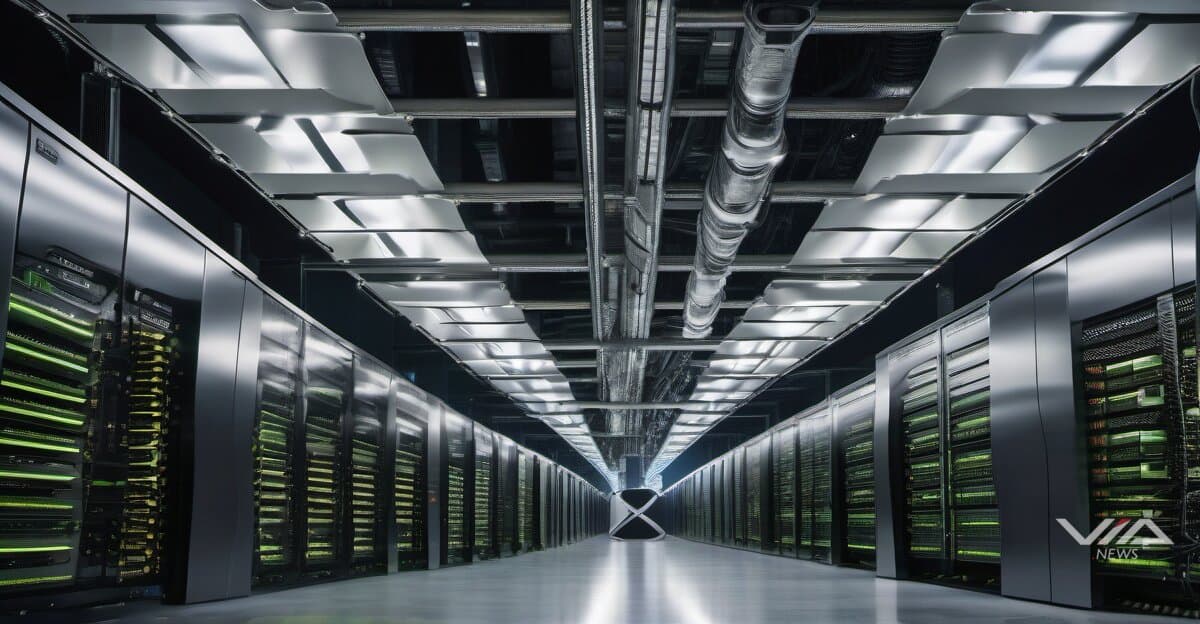
Image generated by AI for illustrative purposes. Not actual footage or photography from the reported events.
Loading stream...

NVIDIA and hyperscaler stocks have reached all-time highs as markets price a structural premium into AI compute infrastructure.1 The driver is a bottleneck thesis tied to US electricity grid constraints limiting how fast AI capacity can scale.

NVIDIA's two-year wealth creation run and concurrent hyperscaler gains share the same narrative: physical infrastructure cannot keep pace with AI compute demand.1 That gap creates durable pricing power for companies that already control the stack — chips, power, cooling, and real estate.

NVIDIA sits at the apex of this trade. Its GPUs remain the dominant hardware for AI training and inference. Supply constraints have kept pricing power elevated even as competition grows. Hyperscalers — the large cloud providers building out AI capacity at scale — benefit from the same scarcity dynamic on the infrastructure side.

Markets are now treating AI compute demand as a downstream energy and infrastructure investment thesis.1 Four sectors are drawing capital: power generation companies supplying data centers, grid operators managing transmission constraints, cooling technology providers solving thermal density problems, and data center REITs that own the physical space where compute runs.

The energy angle is no longer speculative. Dense GPU clusters require sustained, high-density power draws that stress local grid infrastructure. US grid buildout timelines run years, not months. That lag locks in the premium for existing assets.

The trend signal points toward continued outperformance of these infrastructure-adjacent sectors as AI compute demand accelerates.1 Institutional portfolios are embedding the energy investment thesis into capital allocation, not treating it as a satellite position.

One compression risk exists: if grid buildout accelerates faster than expected, or if next-generation chip architectures cut per-inference power requirements, the bottleneck premium narrows. Both scenarios are plausible over a multi-year horizon but are not priced as near-term catalysts.

For now, the stocks hitting all-time highs are the ones that own the physical constraints AI cannot yet route around.

In this story · Knowledge Files

About this analysis

This is a Via News analysis. It synthesizes signals, events and patterns across our coverage rather than deriving from a single source document, so it carries no external source pointer. Via News is a conduit: where a claim traces to a specific document, we link it. How we source

LM Salvado
LM Salvado

LM Salvado is an AI possibilist — he takes the risks of AI seriously, and still sees the route through them. Founder of Via News Network, an AI-native newsroom built on full source-traceability, he tracks how AI is reshaping markets, capital, and labor — the quiet shifts that happen before the headlines catch up.

What we know · the intelligence behind this page
Live from the substrate
What we're seeing
AI Leadership Exodus Rattles Investor Confidence Amid Capex Boom
High-profile departures at top AI labs — Brad Lightcap's exit from OpenAI and an unnamed researcher's departure from Alphabet/Google that triggered a share-price drop — are surfacing talent retention as a market risk factor even as hyperscalers pour record capital into AI infrastructure. The reaction shows investors treating key-person risk at frontier AI labs as material to valuation, a new fragility layered onto an otherwise bullish AI-driven capex cycle.
Our read on the data ›
Signals we're tracking
EPKINLY Regulatory-Clinical Success Cascade
High probability of expanded label indications, additional combination approvals, and competitive positioning strength in follicular lymphoma market. Predicts positive commercial uptake and potential accelerated review for related indications.
Patterns we're watching ›
Where sources disagree
Broadcom Inc.
Both facts report EPS for Broadcom Inc. for the same fiscal period (Q1 2026) observed on the same date (2026-02-01). However, they report conflicting values: 1.5 USD per share vs 2.05 USD per share. This is a 37% difference for the identical metric and time period, not a value change over time.
We flag conflicts openly ›
Recently verified
Checked against the original source
4,978
facts traced to their source — and we flag the ones that don't hold up.
101 entities tracked4,978 facts checked against source5,251 source documents archived
Query this data → isubstrate.com