
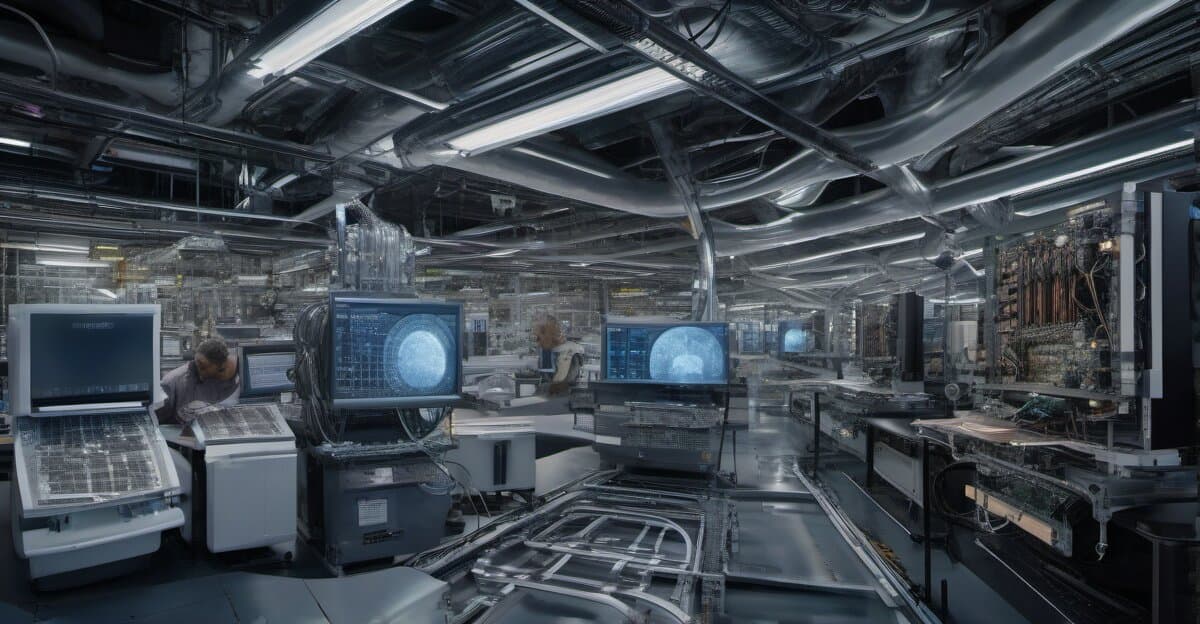
The semiconductor sector is threading a needle between two powerful forces: an unprecedented surge in AI-driven hardware demand and a macro environment that has grown increasingly hostile to risk assets. For investors tracking names like NVIDIA, Broadcom, and AMD, the calculus has rarely been more complex.
At the structural level, the bull case remains intact. Data center buildout continues to absorb compute capacity at a pace that has repeatedly surprised to the upside, while automotive silicon adoption and next-generation photonics are adding new legs to the growth story. Cisco's announcement of its Silicon One G300 underscores how AI networking requirements are reshaping silicon design priorities across the stack — with Yousuf Khan of Cisco stating plainly that "AI at scale demands open, standards-based networking that customers can deploy with confidence across diverse environments."
Further down the supply chain, advanced packaging has emerged as a strategic bottleneck and competitive differentiator. Amkor Technology, the world's largest U.S.-headquartered outsourced semiconductor assembly and test (OSAT) provider, sits at the center of that dynamic. As chipmakers push the limits of traditional scaling, back-end packaging and test services have become as strategically critical as fab capacity — a reality that has drawn renewed investor attention to Amkor's positioning.
On the photonics front, ams OSRAM's Digital Light technology has already secured more than EUR 500 million in design wins, signaling strong commercial traction in automotive and augmented reality verticals. These are not speculative bets — they represent locked-in revenue pipelines that extend the semiconductor growth narrative well beyond the current AI infrastructure cycle.
Yet the macro backdrop is complicating the trade. Gold has pushed to record highs while Bitcoin has softened — a classic risk-off rotation that historically pressures high-multiple tech and semiconductor names. Federal Reserve Chair Powell's term ending has introduced an additional layer of policy uncertainty, and Trump-era interventions — from credit card rate cap proposals to aggressive geopolitical posturing — are adding noise to an already crowded macro calendar.
The geopolitical dimension carries particular weight for semiconductors. China's renewed AI acceleration pledge and a sharp rally in Chinese tech stocks have intensified the U.S.-China competition for AI supremacy, complicating supply chain strategy for companies like Amkor that operate globally. Export controls remain a live variable, and any tightening could ripple through the sector's cost structure and customer mix.
Further out the curve, SiTime's pending acquisition of Renesas's timing business — expected to be accretive to non-GAAP EPS in the first year post-close — illustrates how smaller-cap semiconductor names are using M&A to consolidate niche positions ahead of what many expect to be a multi-year infrastructure supercycle.
Cirrus Logic, meanwhile, has guided Q4 FY26 GAAP gross margins of 51–53%, a solid range that reflects disciplined cost management even as revenue mix evolves.
For traders, the sector presents a bifurcated opportunity: structurally compelling over a 12–24 month horizon, but tactically exposed to macro volatility in the near term. The names with the clearest AI revenue visibility — and the least exposure to China-related policy risk — are likely to weather the storm best. Broadcom's custom ASIC franchise and NVIDIA's data center dominance remain the highest-conviction expressions of that thesis, while Amkor and ams OSRAM offer leveraged plays on the infrastructure layer beneath.