
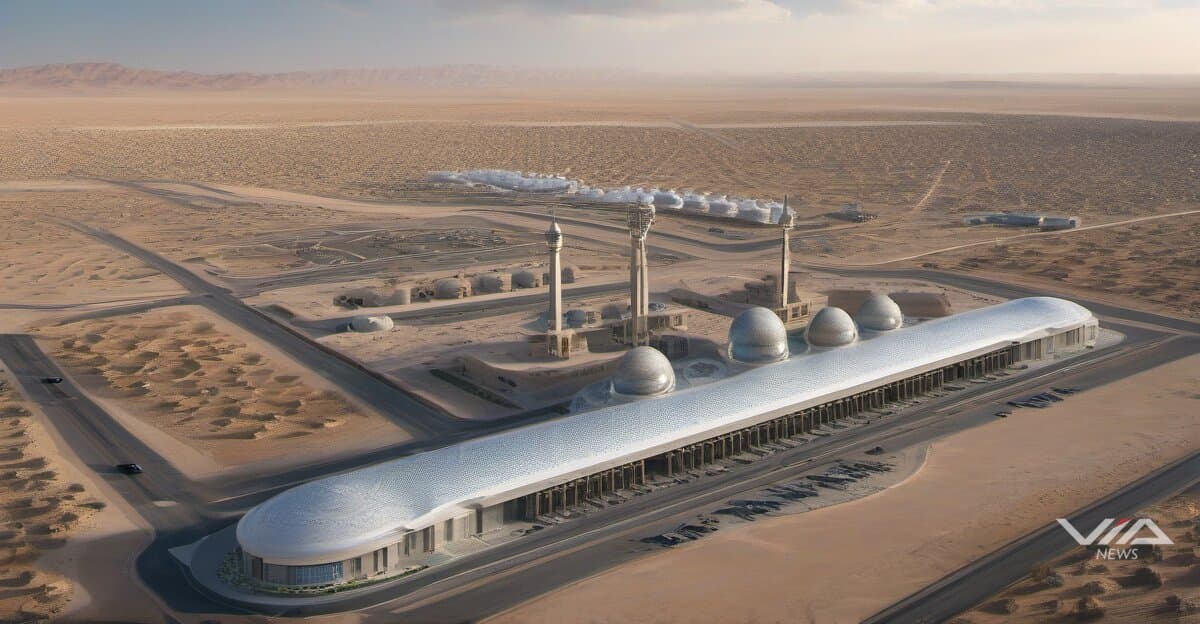
Saudi Arabia has deployed more than $15 billion across major tech providers to build AI infrastructure, with AWS committing $5.3 billion to a Saudi cloud region and Google Cloud partnering with PIF on a $10 billion AI hub.
Nvidia will supply 18,000 Blackwell AI chips to Saudi Arabia through HUMAIN, a government subsidiary. AMD has secured separate AI-chip supply agreements with the kingdom. The hardware orders represent one of the largest sovereign AI infrastructure buildouts outside the US and China.
The spending spree signals Saudi Arabia's strategy to convert oil wealth into AI capabilities. Officials are considering transforming The Line—the futuristic city project—into an AI data-center hub, leveraging existing infrastructure investments.
Market Impact on Cloud Providers
AWS and Google Cloud gain massive enterprise contracts that diversify revenue beyond US markets. The $5.3 billion AWS commitment represents multi-year guaranteed infrastructure spending. Google's $10 billion PIF partnership provides sovereign wealth fund backing for data center expansion.
Cloud infrastructure stocks benefit from visible revenue pipelines. Saudi investments reduce customer concentration risk while proving demand for AI-specific infrastructure at scale.
Semiconductor Winners
Nvidia's 18,000 Blackwell chip order adds to already constrained supply. At estimated $30,000-$40,000 per chip, the Saudi order represents $540 million to $720 million in direct hardware revenue, excluding networking and support infrastructure.
AMD gains diversification beyond hyperscaler customers. Saudi deals provide validation for AMD's Instinct MI300 series against Nvidia dominance in AI training workloads.
Competitive Implications
By 2027, Saudi Arabia aims to publish significant AI research, attract major company R&D centers, and release Saudi-trained LLM models. Success metrics include data center capacity approaching US regional hubs and homegrown model deployments.
Western tech companies gain revenue but create a potential AI competitor. If Saudi Arabia succeeds in building sovereign AI capabilities, it could reduce long-term dependence on US cloud services and chips, similar to China's semiconductor self-sufficiency push.
Investors should monitor Saudi AI research output, data center capacity growth, and chip import volumes as indicators of whether the $15 billion+ investment translates into actual AI capabilities or remains infrastructure without applications.