
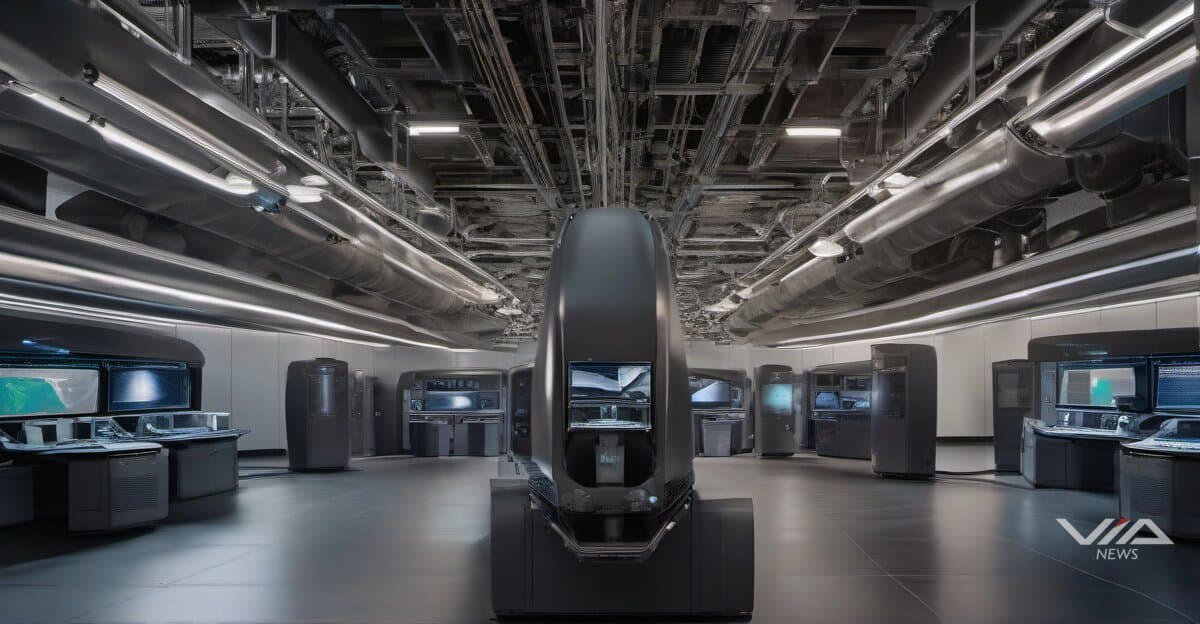
Meta expanded AI data center capital expenditures in Q1 2026, joining a tech sector buildout targeting deep learning infrastructure as enterprises allocate record budgets to GPU clusters and networking hardware.
Cisco shipped next-generation AI networking platforms while AMD released updated GPU software stacks, positioning both companies to capture shares of the estimated $120 billion enterprise AI infrastructure market projected through 2027.
The capex wave follows Stanford AI Lab research showing 20%+ success rate improvements when training models on human video datasets versus robot-only data. The DVD (Domain-Agnostic Video Discriminator) system demonstrated stronger generalization to unseen environments, validating enterprise investment in foundation model training infrastructure.
Autonomous vehicle developers now integrate explainable AI systems to communicate decision-making processes to passengers through audio, visualization, text, and haptic feedback. Post-incident analysis tools help engineers identify safety gaps in neural network architectures.
Medical imaging applications and algorithmic trading platforms show rising adoption of deep learning vision systems, with specialized GPU workloads driving demand for AMD's CDNA architecture and Cisco's 800G Ethernet switches optimized for AI cluster east-west traffic.
Recent architecture advances include TAPINN (Transform-Augmented Polynomial-Informed Neural Networks) and KAN (Kolmogorov-Arnold Networks) evaluations, offering alternatives to traditional multilayer perceptrons for specific computational tasks. Hardware vendors track these developments to align chip roadmaps with evolving model requirements.
Meta's infrastructure expansion supports internal AI product development and potential compute-as-a-service offerings competing with AWS, Azure, and Google Cloud in the enterprise AI market. Analyst estimates place Meta's 2026 AI-related capex between $30-40 billion, primarily targeting H100 and H200 GPU deployments.
AMD gained data center GPU market share in Q4 2025, reaching 12% versus Nvidia's 82%, as hyperscalers diversified silicon suppliers. Cisco positions AI-optimized switching hardware against Arista Networks and Juniper in the $18 billion AI networking segment.
The convergence of algorithmic breakthroughs and hardware availability creates tailwinds for infrastructure vendors as enterprises move from pilot projects to production-scale AI deployments across autonomous systems, medical diagnostics, and quantitative finance applications.