
Wednesday, August 26, 2026

Supermicro's Vera Rubin NVL72 Blueprints Target Hyperscaler AI Factory Orders, Lifting SMCI Outlook

Supermicro launched DCBBS Blueprints for NVIDIA's Vera Rubin NVL72 and HGX Rubin NVL8 platforms on June 1, 2026, offering turnkey reference architectures for large-scale AI factory deployments. The Vera Rubin platform doubles AI factory performance density per Supermicro's claims, potentially accelerating hyperscaler procurement cycles. Analysts are watching SMCI's Q2 and Q3 2026 order backlog for early confirmation of demand.

LM Salvado
LM Salvado

June 5, 2026

Supermicro's Vera Rubin NVL72 Blueprints Target Hyperscaler AI Factory Orders, Lifting SMCI Outlook
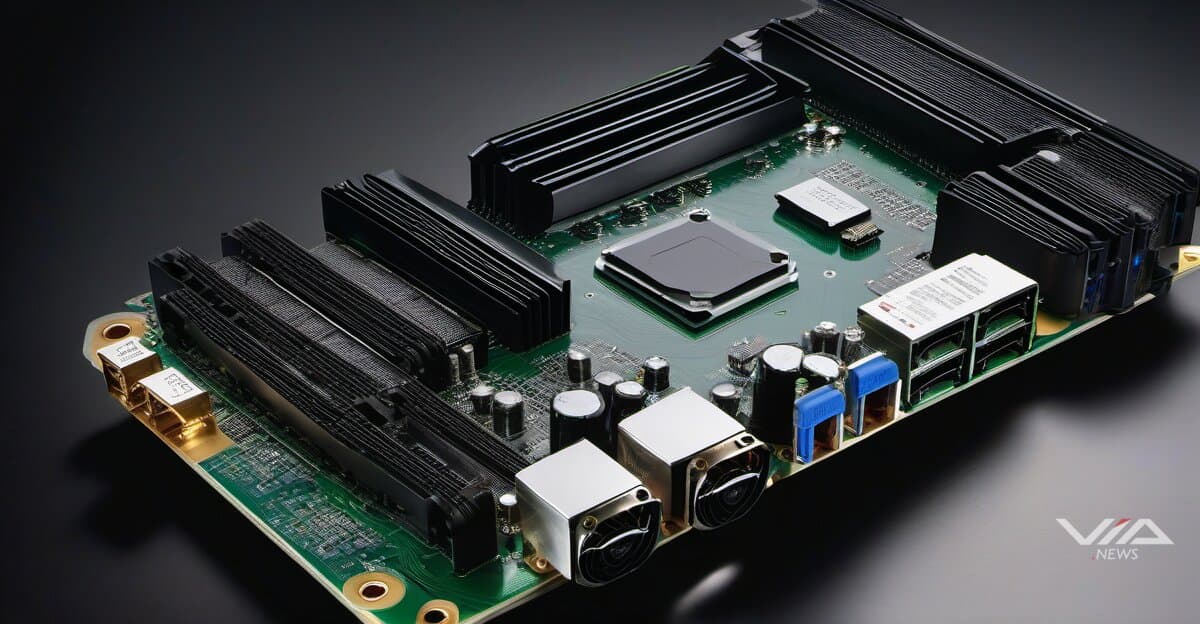
Image generated by AI for illustrative purposes. Not actual footage or photography from the reported events.
Loading stream...

Supermicro launched DCBBS Blueprints for NVIDIA's Vera Rubin NVL72 and HGX Rubin NVL8 platforms on June 1, 2026, targeting hyperscalers seeking faster deployment of next-generation AI infrastructure.1

The Vera Rubin platform doubles AI factory performance density compared to prior generations, according to Supermicro.1 That density gain is material: hyperscalers operating at the margin of data center power capacity can do more compute per rack without expanding physical footprint.

Supermicro's DLC-2 Direct Liquid Cooling technology underpins the blueprint, engineered for near-total heat capture and improved power efficiency.1 Liquid cooling has moved from optional to essential at the rack densities Vera Rubin NVL72 demands — 72 GPUs per system — making thermal management a competitive differentiator, not just an engineering spec.

For SMCI shareholders, the DCBBS Blueprint model matters for one reason: speed. Turnkey reference architectures compress procurement and deployment timelines. Hyperscalers running AI factory buildouts on tight CapEx schedules have less tolerance for custom integration. Supermicro positions its blueprint approach as the shortcut, citing a track record deploying the world's largest liquid-cooled AI factories.1

NVIDIA benefits downstream. Vera Rubin NVL72 adoption is a direct driver of GPU unit volume. Supermicro's early ecosystem commitment signals that the supply chain is ready to move at architecture launch — a faster ramp than the Hopper-to-Blackwell transition. For NVDA, that ramp velocity matters given the valuation multiple the stock carries into 2027.

The execution risk sits entirely with SMCI. Gross margins on systems integration are structurally thin. The company has faced supply chain and accounting scrutiny in recent quarters. Revenue growth from Vera Rubin deployments depends on hyperscaler CapEx cycles that remain sensitive to macro conditions and regulatory developments in AI.

The key data points to watch: SMCI's Q2 and Q3 2026 earnings for order backlog disclosures and Vera Rubin-specific revenue guidance; NVIDIA's data center segment for platform ramp confirmation; and any hyperscaler capital spending announcements that cite Vera Rubin NVL72 deployments by name.

Both SMCI and NVDA sit at the center of AI infrastructure spending. The blueprint model reduces friction — but hyperscaler confirmation of actual deployments, not just purchasing intent, will determine whether this launch moves valuations or just press cycles.

In this story · Knowledge Files

About this analysis

This is a Via News analysis. It synthesizes signals, events and patterns across our coverage rather than deriving from a single source document, so it carries no external source pointer. Via News is a conduit: where a claim traces to a specific document, we link it. How we source

LM Salvado
LM Salvado

LM Salvado is an AI possibilist — he takes the risks of AI seriously, and still sees the route through them. Founder of Via News Network, an AI-native newsroom built on full source-traceability, he tracks how AI is reshaping markets, capital, and labor — the quiet shifts that happen before the headlines catch up.

What we know · the intelligence behind this page
Live from the substrate
What we're seeing
AI Leadership Exodus Rattles Investor Confidence Amid Capex Boom
High-profile departures at top AI labs — Brad Lightcap's exit from OpenAI and an unnamed researcher's departure from Alphabet/Google that triggered a share-price drop — are surfacing talent retention as a market risk factor even as hyperscalers pour record capital into AI infrastructure. The reaction shows investors treating key-person risk at frontier AI labs as material to valuation, a new fragility layered onto an otherwise bullish AI-driven capex cycle.
Our read on the data ›
Signals we're tracking
EPKINLY Regulatory-Clinical Success Cascade
High probability of expanded label indications, additional combination approvals, and competitive positioning strength in follicular lymphoma market. Predicts positive commercial uptake and potential accelerated review for related indications.
Patterns we're watching ›
Where sources disagree
Broadcom Inc.
Both facts report EPS for Broadcom Inc. for the same fiscal period (Q1 2026) observed on the same date (2026-02-01). However, they report conflicting values: 1.5 USD per share vs 2.05 USD per share. This is a 37% difference for the identical metric and time period, not a value change over time.
We flag conflicts openly ›
Recently verified
Checked against the original source
4,978
facts traced to their source — and we flag the ones that don't hold up.
101 entities tracked4,978 facts checked against source5,251 source documents archived
Query this data → isubstrate.com